Choosing a payments provider for an international company: a CFO's checklist
Before a company moves money through a new payments provider, confirm eight things: which accounts and currencies you get, the total cost of your actual route, limits, which rails are available, what the business review will ask, which legal entity is your counterparty, what records you receive, and who your named contact is.

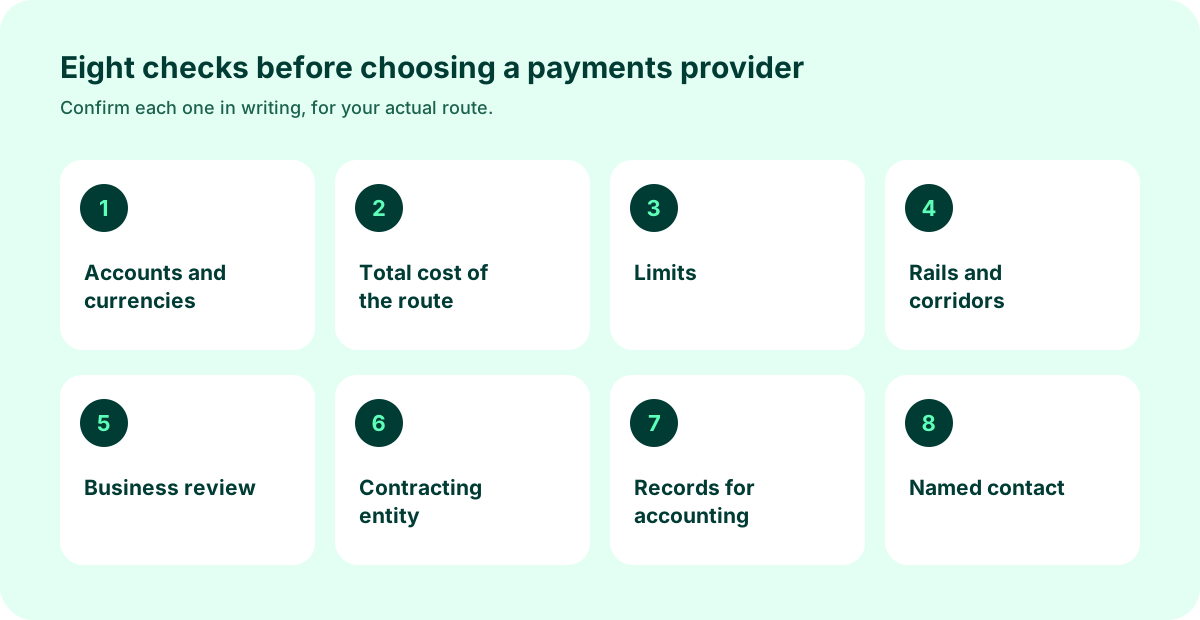
Each check below follows the same pattern: what to confirm, what it looks like when it is in order, a red flag, and one question to send the provider word for word. Ask for every answer in writing.
1. Accounts and currencies
Find out which accounts you get, in which currencies, and whose name is on them. Account details in your company's name read differently to a client than details that belong to the provider. Check which details you can put on an invoice.
"Which currencies can my company hold, and whose name is on the account details I give my clients?"
2. The total cost of your actual route, not one rate
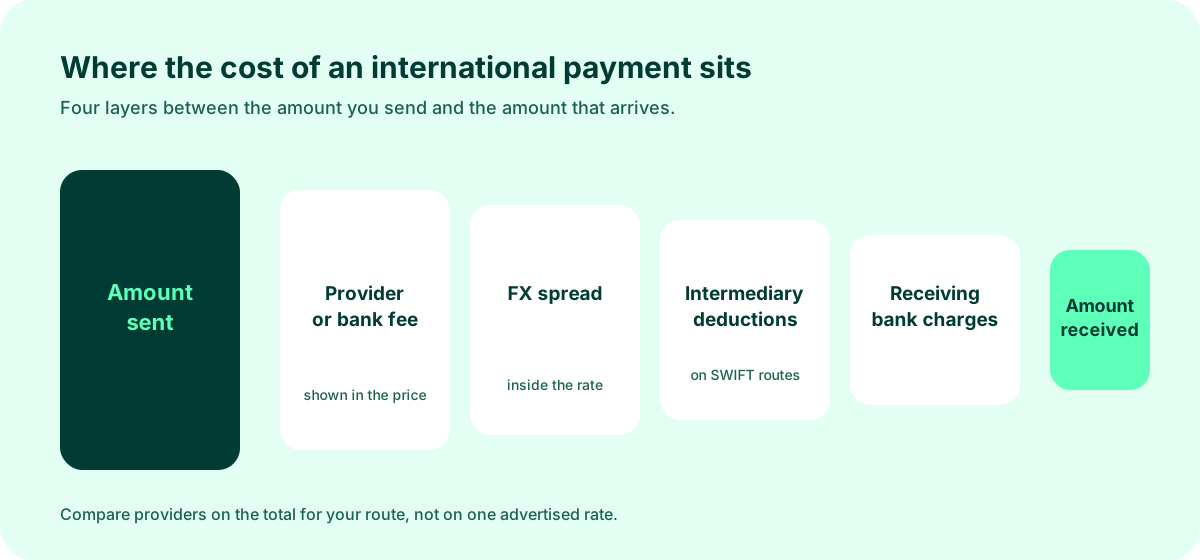
One advertised rate tells you little. The real cost of a route adds up four layers: the provider's fee, the FX spread, deductions by intermediary banks, and the charges of the recipient's bank. We break these down in where the cost of a cross-border payment sits.
- In order: a written quote for your specific route, stating what it includes and what it does not.
- Red flag: a price "below market" with no explanation of what it is made of.
"Quote my route end to end in writing: what leaves my account, and what lands in the recipient's account?"
3. Limits
Ask about limits per payment, per day and per month, what happens when a payment exceeds them, and whether they change after the first months. A limit you discover on payout day is the expensive kind. This matters most for teams paying partners in several countries.
"What are the limits on day one, and what changes them?"
4. Rails and payout corridors
Find out which rails are available and where the money actually reaches. USD via ACH, USD via Wire, USD via SWIFT and EUR via SEPA cover different ground; they are not interchangeable. See ACH, Wire, SWIFT and SEPA compared.
"Which rail will my payment actually use, and which bank clears it?"
5. The business review: what they will ask
A business review usually covers company registration documents, the legal form and address, the ownership structure, and identification of directors and beneficial owners. A well-run provider tells you the document list in advance and explains each step.
- In order: you know the list before you apply, and someone explains what happens at each stage.
- Red flag: approval before any documents, or a refusal to say what will be checked.
"Send me the document list before I apply."
6. Your counterparty: which legal entity and where
Confirm which legal entity signs the contract with you, where it is registered, and which banks clear your payments. Read the contract, the website and the payment details side by side.
- Red flag: nobody can tell you in writing which entity signs your contract.
"Which legal entity is the contracting party, and which banks clear my payments?"
7. Records your accountant will need
Ask what you receive for each transaction and in what form, whether it will match your accounting system, and what you can show an auditor. Teams receiving client payments from abroad feel this first: every incoming payment needs a record that ties it to an invoice.
"Show me a sample statement before I sign."
ArtPay provides transaction records for reconciliation. For how to treat a specific transaction in your books, consult your accountant.
8. Who your contact is
A ticket system and a named manager are different things when a payment goes missing. Find out who you call, how quickly a payment can be traced, and whether there is an escalation path. With ArtPay, each client has a named manager.
"Who is my named contact, and what happens when a payment goes missing?"
Fill this in for each provider you are comparing
Copy the table, send the questions to each provider you are considering and fill in their written answers. A side-by-side page like this is easier to defend in a board meeting than a list of features.
| # | What to confirm | The question to ask | Provider A | Provider B |
|---|---|---|---|---|
| 1 | Accounts and currencies | Which currencies, whose name on the details | ||
| 2 | Total cost of the route | Quote my route end to end, in writing | ||
| 3 | Limits | Limits on day one, and what changes them | ||
| 4 | Rails and corridors | Which rail, which bank clears it | ||
| 5 | Business review | Send the document list before I apply | ||
| 6 | Contracting entity | Which legal entity, which banks | ||
| 7 | Records | Show me a sample statement | ||
| 8 | Named contact | Who do I call when a payment is missing | ||
| 9 | Digital-asset revenue (if any) | What it settles into, and on whose account |
| Check | In order | Red flag |
|---|---|---|
| Accounts | Details in your company's name, currencies listed | Unclear whose name the details carry |
| Total cost | Written quote for your route, all layers named | One rate, nothing about FX or intermediaries |
| Limits | Stated in writing, with what changes them | "We'll see" until the first large payment |
| Rails | Rail and clearing bank named per currency | "We cover everywhere" with no rail named |
| Review | Document list sent before you apply | Approval promised before any review |
| Entity | Contracting entity named in writing | Entity not stated before you sign |
| Records | Sample statement provided on request | Records described only in general terms |
| Contact | A named person and an escalation path | Only a generic inbox |
If part of your revenue arrives in digital assets, add a ninth line: what it settles into, on whose account, and who confirms the terms in writing. With ArtPay, that is a settlement of digital-asset revenue (USDT, USDC) into USD or EUR on the company account; from there the funds move on the usual rails.
When you do not need any of this
- You need card payments on your website. That is card acquiring, a different product; ArtPay is not a card acquirer. More on what ArtPay does and does not do for online stores.
- You do not have a registered company. ArtPay does not onboard individuals without a registered company.
- All your payments stay in one country and one currency. Your existing bank is usually enough.
Questions
What should a company check before choosing an international payments provider?
Accounts and currencies, the total cost of the actual route rather than one advertised rate, limits, which rails and corridors are available, what the business review will ask for, which legal entity is the contracting party, what records are issued, and who the named contact is. Confirm each one in writing.
How is ArtPay pricing calculated?
ArtPay charges a transparent fixed fee. There is no published rate card: the fee depends on your routes and your monthly volume, and it is confirmed in a written quote before activation. Describe your flow — where the money comes from, what it converts into, where it goes — and a manager prepares the quote.
What happens during an account review?
ArtPay reviews each business before onboarding, and accounts and transactions may be reviewed afterwards under applicable policies. A business review normally covers company registration documents, the legal form and address, the ownership structure, and identification of directors and beneficial owners. Each client has a named manager who explains the next steps where permitted.
Which currencies and payment rails does ArtPay support?
USD via ACH and Wire through SSB Bank, USD via SWIFT through Portage Bank, and EUR via SEPA through ClearBank. ArtPay converts between USD and EUR with a fixed fee confirmed in writing, and also settles digital-asset revenue in USDT and USDC into USD or EUR on the company account.
Does ArtPay accept card payments on my website?
No. ArtPay is not a card acquirer and does not process customer card payments on merchant websites. ArtPay helps a registered company receive funds from clients, partners, marketplaces and platforms, convert them, hold them in a business account, pay partners and contractors, and spend through corporate cards.
This guide is general information, not legal, tax or financial advice. Payment rules and timings vary by bank and country; confirm the details for your route with your provider.