Cross-border settlements for international companies: ACH, Wire, SWIFT and SEPA explained
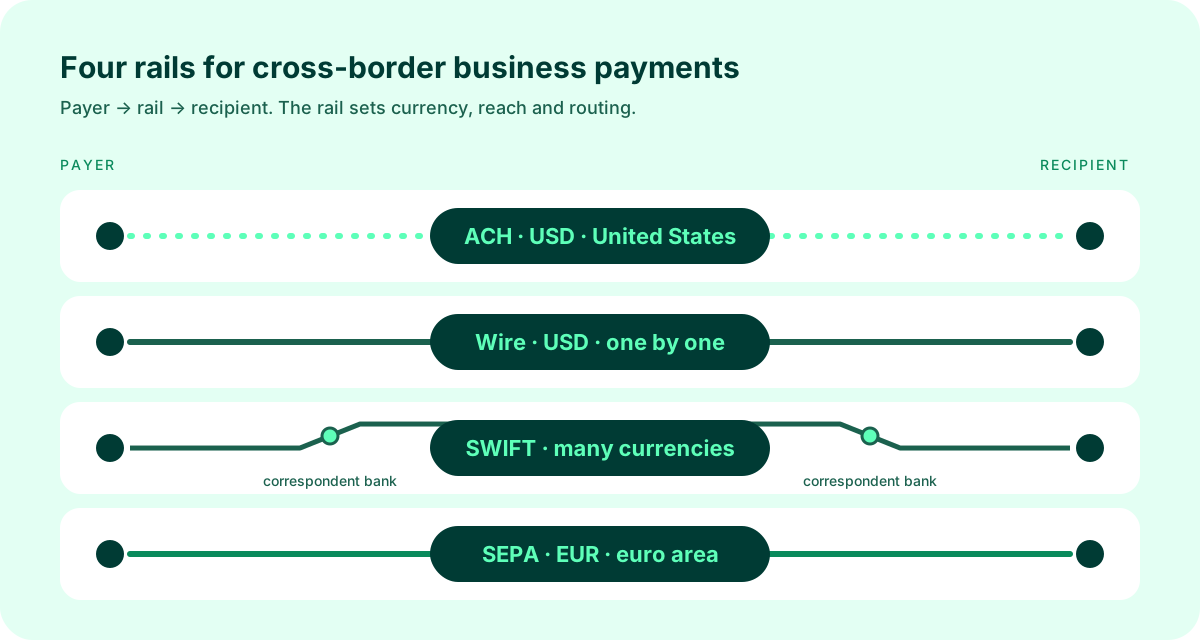
Four rails carry most business cross-border money. ACH moves USD inside the United States in batches. Wire moves USD one payment at a time. SWIFT carries payment instructions between banks worldwide, usually through correspondent banks. SEPA moves euro across its member countries as a single domestic area. The rail sets your currency, routing, cost and paperwork.

What a payment rail actually is
A payment rail is the agreed way money moves between banks: which currency it carries, which message format the banks use, and who takes part. When finance teams say a payment "went by SWIFT" or "went by SEPA", they are naming the rail.
Two layers get mixed up. A messaging network carries instructions: it tells the next bank what to pay and to whom. A payment scheme sets the rules for a type of payment, and clearing and settlement systems move the money between banks under those rules. SWIFT is a messaging network. ACH and SEPA are payment schemes: ACH payments clear through operators such as FedACH, and SEPA payments through clearing and settlement mechanisms such as STEP2 or TIPS. That difference explains most of what surprises companies about international payments.
For a business, the rail matters less for raw speed and more for predictability: whether the full amount arrives, what the recipient sees on their statement, and how much work your team does to reconcile it.
ACH: USD inside the United States
ACH is the domestic US rail for dollar payments. Banks submit payments in batches and the network settles them together. It does not reach outside the United States: the recipient needs an account at a US bank.
Because it works in batches, ACH is usually the lower-cost option and fits recurring payments: contractor fees, regular supplier bills, payroll-style runs. Standard ACH entries in the United States typically settle within one to two business days, and a same-day option exists for eligible payments.
Wire: USD payment by payment
A wire is processed as an individual payment, not as part of a batch. Each wire costs more to send, and in return the payment moves on its own and is easy to trace.
Companies use wires when an amount is large or a deadline is fixed: a supplier deposit, a closing payment, a time-sensitive transfer. The short version: ACH is a batch, a wire is a single, individually handled payment.
SWIFT: instructions that travel between banks
SWIFT is a messaging network that banks use to send payment instructions to each other. It does not move money by itself. When the sending and receiving banks have no direct relationship, the money travels through one or more correspondent banks that hold accounts with each other.
The practical consequence for a finance team: each bank in that chain can deduct its own charge. The recipient can see less than you sent. That is how the rail works, not a mistake by one bank.
This is why SWIFT instructions carry a charge code. OUR means the sender pays all charges. SHA means charges are shared: the sender pays their bank, the recipient pays the rest. BEN means the recipient pays everything. If a contract or invoice says "payment in full", agree the charge code with your counterparty in writing.

SEPA: euro as one domestic area
SEPA, the Single Euro Payments Area, is a set of euro payment schemes run under rules from the European Payments Council. It lets a euro payment between member countries work like a domestic one. The format is standard: an IBAN, a BIC where required, and one field for the payment reference. SEPA only carries euro.
If your clients are in Europe, holding EUR account details changes their experience: they pay you as they would pay a local supplier. Converting everything to USD on arrival adds a currency step to every invoice. See how this works when receiving payments from clients abroad.
Where the cost of a cross-border payment actually sits
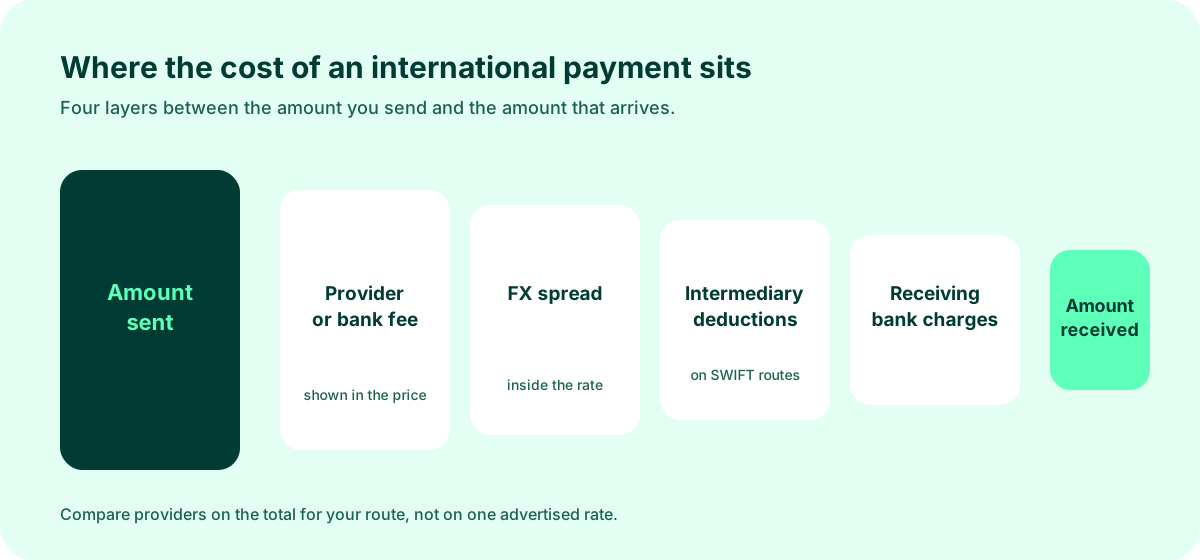
The price on a provider's page is only one of four layers. Take a USD 50,000 payment (example): by the time it lands, four different parties may have taken a share.
- Provider or bank fee. The advertised charge, and usually the only one in the price list.
- FX spread. The gap between the mid-market rate and the rate your payment is executed at. It is often the largest layer, and it does not look like a fee.
- Intermediary deductions. Charges taken by correspondent banks on SWIFT routes.
- Receiving bank charges. Incoming fees and local charges at the recipient's bank.
| Cost layer | Who charges it | Visible in the quote? | What to ask |
|---|---|---|---|
| Provider or bank fee | Your provider or bank | Yes, usually | Is this the full fee for my route? |
| FX spread | Whoever converts the currency | Often not | Which rate will you apply, and against what reference? |
| Intermediary deductions | Correspondent banks on SWIFT | Rarely | Which charge code will you use: OUR, SHA or BEN? |
| Receiving bank charges | The recipient's bank | No | What does the recipient's bank usually deduct? |
Comparing providers on one rate tells you little. Compare the total for a specific route: what leaves your account and what lands in the recipient's. Our checklist shows how to compare the total cost of a route.
What changes when volumes grow
One payment a month and two hundred payments a month are different problems. At volume, the fee stops being the main cost. Reconciliation and manual work take its place.
- What breaks: similar account details for different recipients, payment references that never reach the statement, several currencies mixed in one account.
- What helps: one account per currency, the same reference format for every payment, and a named contact at your provider instead of a ticket queue.
If your team runs regular payout rounds, see how ArtPay approaches paying partners across several countries.
Choosing a rail: a quick reference
| Rail | Currency | Reach | Choose it when |
|---|---|---|---|
| ACH | USD | United States | Recurring USD payments to US accounts, and cost matters more than speed |
| Wire | USD | United States and, via correspondents, abroad | Large or time-critical USD payments processed individually |
| SWIFT | Multi-currency | Worldwide | The recipient's bank is outside ACH and SEPA reach |
| SEPA | EUR | SEPA member countries | Any euro payment to a counterparty inside the SEPA area |
ArtPay settles USD via ACH and Wire through SSB Bank, USD via SWIFT through Portage Bank, and EUR via SEPA through ClearBank. You can read more about how settlements reach a company account.
Some companies receive part of their revenue in digital assets. For them the question is the same as for any other income: how it becomes USD or EUR on the company account, at what total cost, and with what records. With ArtPay this is a settlement of digital-asset revenue (USDT, USDC) into USD or EUR on the company account. After that, the funds move on the same rails as any other payment: ACH, Wire, SWIFT or SEPA.
Sources: Nacha — what ACH is, European Payments Council — SEPA schemes and clearing and settlement mechanisms, Swift — about the network.
Who this is for, and who it is not for
Registered companies with international payment flows: partner networks, performance and media buying agencies, IT outsourcing firms, exporters, trading companies and studios, and digital agencies and SaaS companies with clients and contractors abroad. ArtPay does not onboard individuals without a registered company. A personal app is in development.
Questions
What is the difference between ACH and a wire transfer?
ACH processes USD payments in batches inside the United States. A wire is processed as an individual payment. ACH is the cheaper option for recurring payments; a wire is used when a payment is large or time-critical. Both are USD rails and both require the recipient to hold a bank account that can receive them.
Is SWIFT a payment system?
No. SWIFT is a messaging network that banks use to send payment instructions to each other. The money itself moves through correspondent-bank relationships, which is why a SWIFT payment can pass through intermediary banks and why each of them can deduct a charge before the funds reach the beneficiary.
Which currencies and payment rails does ArtPay support?
USD via ACH and Wire through SSB Bank, USD via SWIFT through Portage Bank, and EUR via SEPA through ClearBank. ArtPay converts between USD and EUR with a fixed fee confirmed in writing, and also settles digital-asset revenue in USDT and USDC into USD or EUR on the company account.
How is ArtPay pricing calculated?
ArtPay charges a transparent fixed fee. There is no published rate card: the fee depends on your routes and your monthly volume, and it is confirmed in a written quote before activation. Describe your flow — where the money comes from, what it converts into, where it goes — and a manager prepares the quote.
Does ArtPay accept card payments on my website?
No. ArtPay is not a card acquirer and does not process customer card payments on merchant websites. ArtPay helps a registered company receive funds from clients, partners, marketplaces and platforms, convert them, hold them in a business account, pay partners and contractors, and spend through corporate cards.
What other revenue can ArtPay settle into USD or EUR?
Revenue in digital assets: a registered company can have revenue it receives in USDT or USDC settled into USD or EUR on its company account. Funds then move via ACH, Wire, SWIFT or SEPA like any other settlement. Eligibility is reviewed for each business, and the fee is confirmed in a written quote.
This guide is general information, not legal, tax or financial advice. Payment rules and timings vary by bank and country; confirm the details for your route with your provider.