Paying partners and contractors in several countries: how finance teams run payout day
A reliable payout day has four parts: funds arrive in the company account, the team converts only what it needs at a fee it knows in advance, each partner is paid on the rail that fits their currency, and the accountant can match every payout to a record. Most problems start where these steps live in different tools.

What payout day looks like
For a partner network or a performance agency, payout day is the moment a month of work turns into money in other people's accounts. Dozens or hundreds of partners and contractors expect to be paid on time, in their own currency, and with the right amount.
- Funds arrive. Revenue from advertisers, networks and clients lands in the company account.
- You convert what you need. Some partners are paid in USD, some in EUR. You convert the difference, ideally at a fee you agreed in writing.
- You pay out. Each payment goes on the rail that matches the partner's currency and bank.
- You reconcile. The accountant matches every payout to an invoice or a partner statement.
Three places where payout day breaks
1. Too many tools for one round
Receiving in one place, converting in another and paying out from a third means three sets of fees, three sets of statements and three places where something can stall. The team spends payout day moving money between its own accounts.
2. The cost you see only afterwards
When the conversion rate and the payout charges become clear only after the money has moved, the finance team cannot plan the round. On SWIFT routes, intermediary banks may also deduct charges, so a partner receives less than you sent. We explain these layers in where the cost of a cross-border payment sits.
3. Records that don't match
If payout references never reach the statement, or several partners share similar details, reconciliation turns into detective work. Screenshots replace records, and the month-end close slips.
Choosing the rail for each partner
| Partner is paid in | Partner's bank is | Rail to use |
|---|---|---|
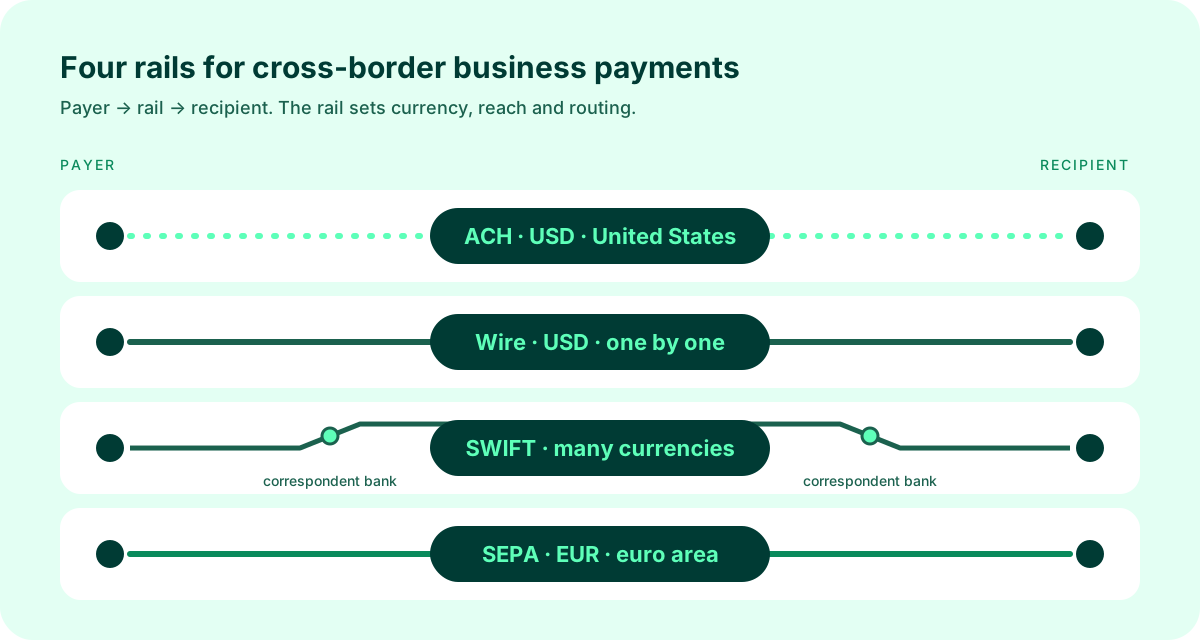
| USD | In the United States | ACH for regular payouts, Wire for large or urgent ones |
| USD | Outside the United States | SWIFT |
| EUR | In the SEPA area | SEPA |
| EUR | Outside the SEPA area | SWIFT |
Keeping the rail consistent per partner makes each round predictable: the same partner, the same route, the same fee.
How to make reconciliation boring
- One reference format for every payout: partner ID, period and invoice number, in the same order every time.
- One account per currency, so USD and EUR flows never mix in a single statement.
- A partner register with each partner's currency, bank and rail, updated before payout day, not during it.
- A written fee quote for each route, so the expected cost of the round is known before it starts.
Covering ad spend with a corporate card
Performance teams also pay for traffic. A corporate card linked to the same account keeps ad spend in the same records as partner payouts, instead of in a separate service. ArtPay offers card options to eligible businesses where supported.
A payout-day checklist
| Check | Why it matters |
|---|---|
| Funds for the round are in the right currency account | No last-minute conversions at an unknown rate |
| Each partner has a confirmed rail and bank details | Fewer returned or delayed payments |
| Fees for each route are confirmed in writing | The round's total cost is known in advance |
| References follow one format | The accountant can match every payout |
| Someone owns exceptions | A named person handles anything that fails |
Some networks receive part of their revenue in digital assets. The same rule applies: settle it into USD or EUR on the company account first, then pay partners on the usual rails. With ArtPay, that is a settlement of digital-asset revenue (USDT, USDC) into USD or EUR, with the fee confirmed in writing.
Who this is for
Partner networks, performance and media buying agencies, and any registered company that pays partners or contractors in several countries. It is not a fit for individuals without a registered company. See how ArtPay approaches partner and contractor payouts.
Questions
How do I pay partners in several countries from one account?
Hold balances in the currencies you pay out, and pay each partner on the rail that fits their currency and bank: ACH or Wire for USD in the United States, SEPA for EUR in the SEPA area, SWIFT for the rest. Agree the fee for each route in writing before the round.
Why does a partner receive less than we sent?
On SWIFT routes, intermediary banks and the recipient's bank can each deduct a charge. Agree the charge code (OUR, SHA or BEN) with the partner and confirm the route's total cost with your provider in advance.
Which currencies and payment rails does ArtPay support?
USD via ACH and Wire through SSB Bank, USD via SWIFT through Portage Bank, and EUR via SEPA through ClearBank. ArtPay converts between USD and EUR with a fixed fee confirmed in writing, and also settles digital-asset revenue in USDT and USDC into USD or EUR on the company account.
How is ArtPay pricing calculated?
ArtPay charges a transparent fixed fee. There is no published rate card: the fee depends on your routes and your monthly volume, and it is confirmed in a written quote before activation. Describe your flow — where the money comes from, what it converts into, where it goes — and a manager prepares the quote.
This guide is general information, not legal, tax or financial advice. Payment rules and timings vary by bank and country; confirm the details for your route with your provider.